Your AI dashboard is measuring the wrong thing
Ask a room of executives how AI adoption is going in their organisation and most will reach for the same evidence: a dashboard. Seats licensed. Tokens consumed. Weekly active users, trending up and to the right.
It is a genuinely reassuring picture. It is also close to useless.
That dashboard cannot see the analyst running half her work through a personal account because the corporate tool is slower. It cannot tell you whether the team with the highest usage is doing anything that matters to the business, or simply generating a great deal of text. It cannot tell you that your most experienced underwriter has quietly stopped exercising the judgement that made him valuable, because the model does a passable version in four seconds.
Usage is not capability. And right now, most organisations are measuring the first and assuming the second.
Adoption happened to you
Here is what actually occurred in most enterprises over the past two years.
AI arrived through three doors at once. It came in officially, through a platform rollout and a launch email. It came in through the back door, on personal accounts, because people found something that worked. And it came in silently, through vendor updates that added AI features to software you have owned for a decade.
Nobody designed the shape of that. It simply spread unevenly, invisibly, and at wildly different depths depending on which desk you look at. One person has genuinely restructured how they work. The person beside them has not opened the tool since the training session. Their manager cannot tell you which is which.
This is accidental adoption, and it is the default state. Not because anyone was negligent, but because the technology moved faster than anyone's ability to put discipline around it.
The alternative is not more control. It is more deliberateness.
Four questions your dashboard cannot answer
Who is actually capable, and at what? Fluency varies enormously and invisibly. Self-assessment does not help — people either overrate themselves or genuinely do not know what they are missing.
Is any of this pointed at something that matters? Enthusiastic AI use aimed at low-value work looks identical to success on a usage chart.
What are you quietly losing? Every task handed to a model is a skill that stops being practised. Much of that is fine, even desirable. Some of it is the capability your organisation exists to sell. Nobody is currently deciding which is which — it is simply happening.
What should you be automating that you have not noticed? The best automation candidates are rarely visible from the top. They are the workarounds and Tuesday-afternoon rituals that individuals have never thought to mention.
None of these are technology questions. They are all questions about people, and none of them can be answered from a log file.
Deliberate AI Adoption
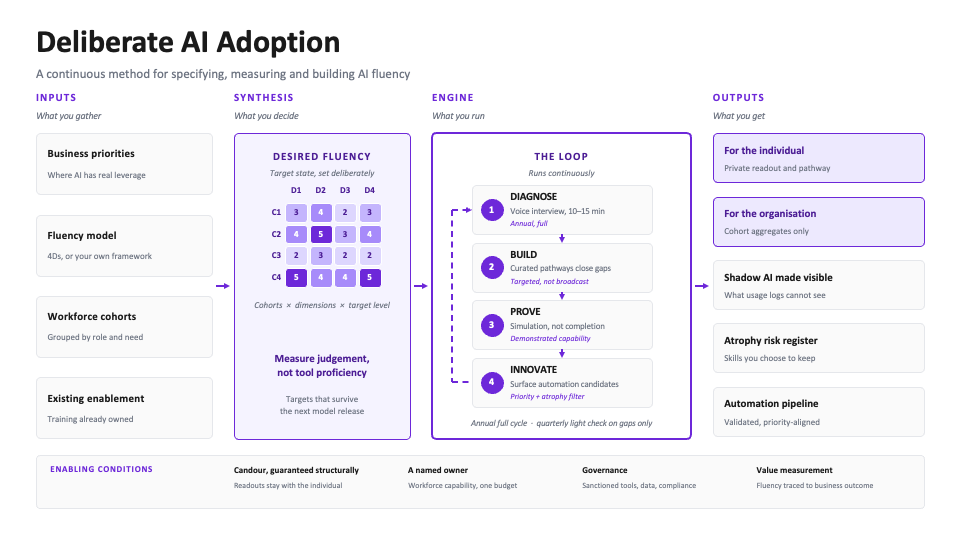
If accidental adoption is the problem, the response is a method that treats fluency as something you can specify, measure and build — rather than something you hope for.
Start with business priorities, not strategy. The usual first question is whether the organisation has an AI strategy. Worth asking, but its absence is not a blocker. Treating it as one is exactly where a great many organisations have become stuck, rewriting a document that events overtake before it is approved. The sharper question is which business priorities would be most transformed by disciplined AI use. You can answer that today.
Define the fluency you actually want. Not everyone needs to be excellent at everything. Segment the workforce into cohorts, pick a fluency model — Anthropic's AI Fluency Framework is a well-grounded default, though your own competency framework works just as well. Set a deliberate target for each cohort against each dimension, justified by that cohort's line of sight to a priority.
One caveat that matters: measure judgement, not tool proficiency. "Competent with the current assistant" expires with the next release. "Knows which work to hand over and which to keep" does not.
Diagnose through conversation, not survey. A short voice-led interview, ten to fifteen minutes, adapting its questions to what it hears. Voice matters more than it sounds: people self-edit when they type, but talk to them and you get the messy detail like the workaround, the unsanctioned tool, the task that eats their Tuesday. That texture is where the findings live.
The critical design decision is who sees what. The individual gets their own readout immediately, and it stays theirs. The organisation gets cohort-level aggregates only. Get this wrong and the whole thing becomes surveillance with a friendly interface, and your data quality dies the moment one sceptic says so out loud.
Prove capability, not completion. Course completion measures attendance. Each pathway should end in a simulation where the person demonstrates the competency in a realistic situation from their own working context. Delegation is not knowledge you can quiz. It is a judgement call, and only a scenario surfaces it.
Then turn the same instrument outward. Once you know how well people work with AI, ask what in their work AI should be doing. The same conversational approach surfaces automation candidates, each filtered through two questions: does it serve a business priority, and does automating it erode something you need to keep?
That second filter is the atrophy question, asked at the point of decision rather than parked in a risk register.
Why "deliberate"
The word is doing real work. It is the precise opposite of what has happened so far — tools arriving unbidden, capability landing wherever it lands, skills disappearing without anyone choosing to let them go.
It protects against the reflex response to an AI skills gap, which is to put the entire workforce through the same catalogue of courses. There are hundreds of them. Most people need a fraction, and the fraction differs by cohort. Broadcasting training does not just waste time, it buries the material people genuinely need and teaches everyone that AI enablement is something to be endured.
This is a synthesis of a problem unfolding right now, not a method with a decade of case studies behind it. Nobody has that, and anyone claiming otherwise is relabelling something older.
What I am confident about is the diagnosis. The gap between what usage dashboards show and what leaders actually need to know is real, it is widening, and the organisations that close it deliberately will pull away from the ones still waiting for the strategy document to be finished.